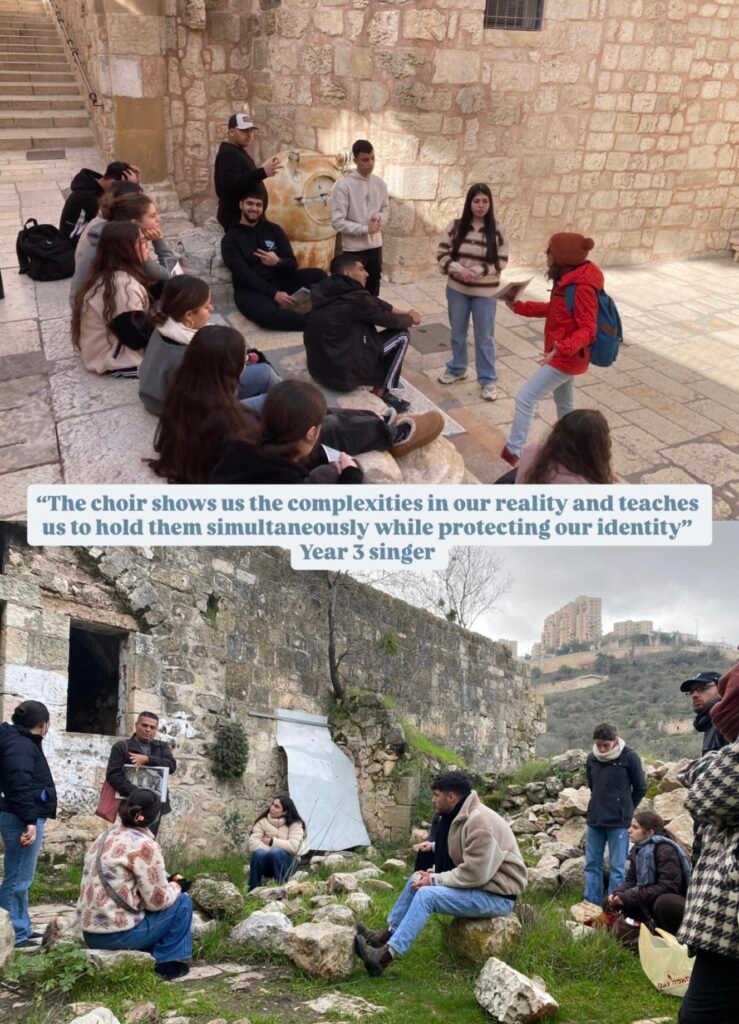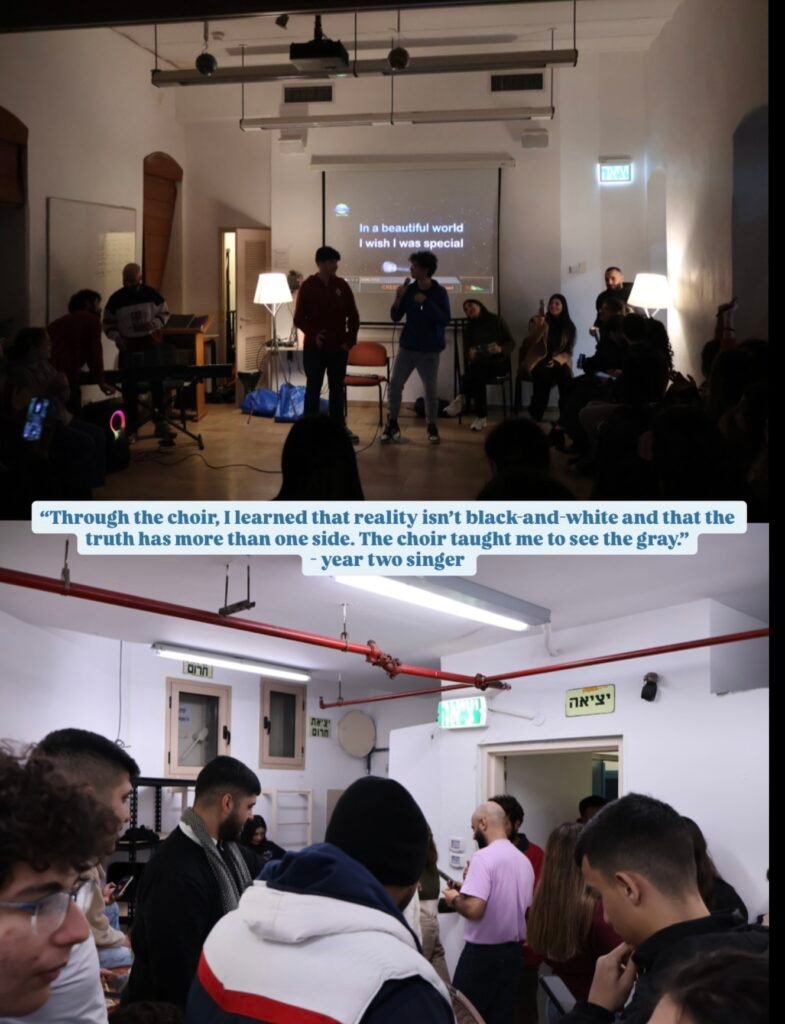
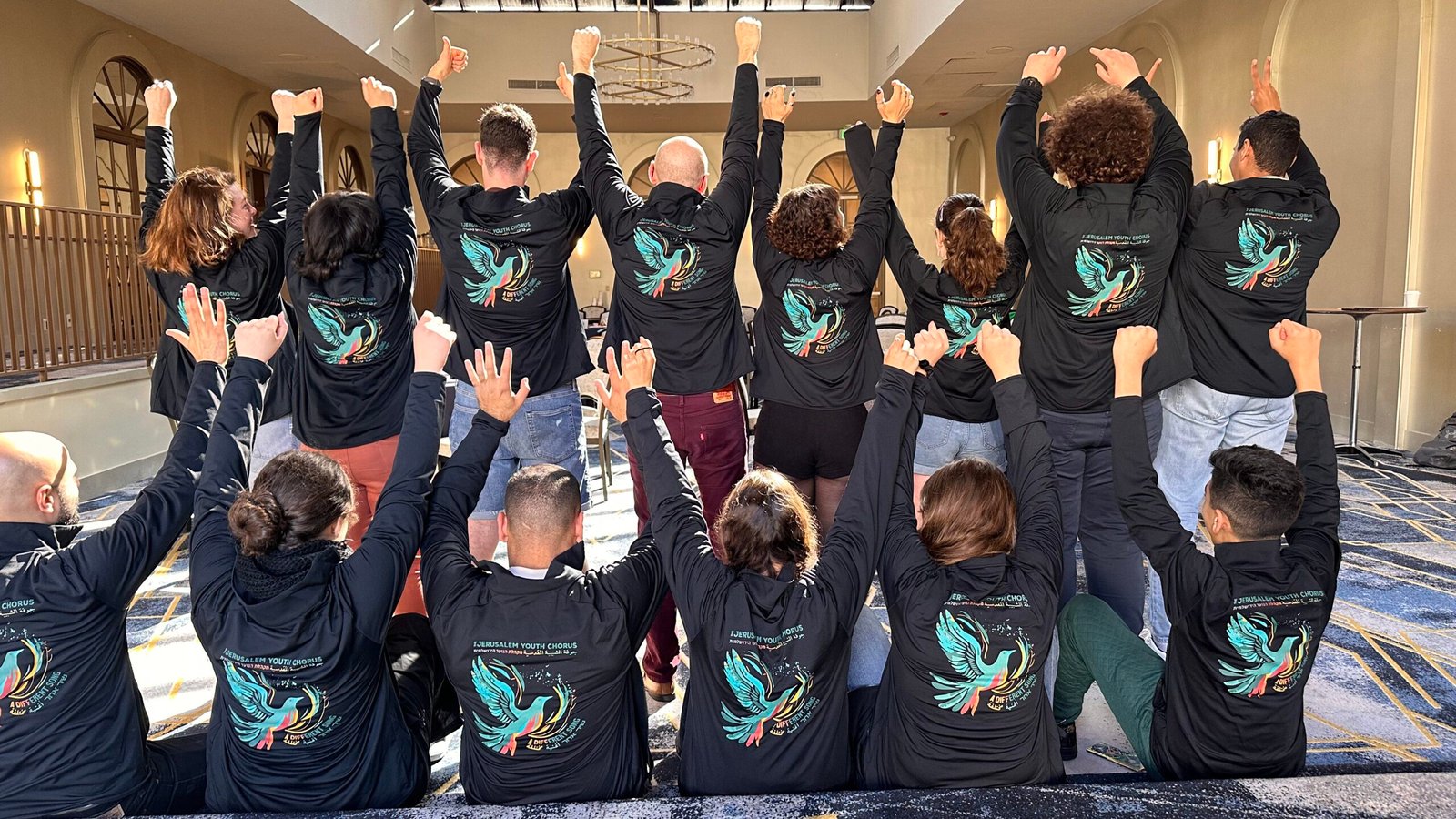
The Jerusalem Youth Chorus is built on connection and shared realities, yet each one of our singers holds thousands of stories that shape their individuality and show how, despite living close, their realities often feel completely different.
One of the core purposes of the choir is to offer a space to hold these multiple truths and to provide a safe environment for them to share their stories.
This section is dedicated to the voices that build JYC, the reason we sing.
This is a deeper dive into the singers’ personal experiences and lives. Here, we read the stories written by our JYC singers themselves.
The stories of the Jerusalem Youth Chorus
The Moment Before Innocence Disappears: A story written by Hadas, a 17-year-old Israeli JYC singer
I see my neighbors all the time now, in the bomb shelter.
We sit together in a place filled with fear, cut off from the rest of the world, waiting for permission to return to it. Every time the adults see each other, they get disappointed because it means another siren, another bomb attack.But the kids are always excited.
They go down to the bomb shelter, hoping for a siren; the excitement draws them in. They’re not afraid of the bombs, of the explosions. They see it as an experience. I asked the kids what they thought about the war, and they all said they were happy since they didn’t have school.I wish I could see it that way.
But I’m no longer like that. I’m like the adults. Every siren is a disappointment.But I can still appreciate the children’s point of view. I can cherish their youth and innocence, their ability to see the world with an open mind.
It inspires me.
And I want them to stay that way. I want them to live in a world that allows them to preserve that innocence, something that cannot be regained once you outgrow and lose it.Every generation, once they become adults, says, “I want to change the world for my kids. I don’t want them to grow up with the pain and loss I grew up with. I want them to grow up and live as children, the way all humans deserve.” I remember my parents saying the same thing to me.
And now, I say the same thing.I don’t have children yet. But it’s too late for me to have the childhood my parents wished for me, the one all parents wish for their children. I see the kids, and I know that one day they will say the same things. They will make the same wishes.
My childhood was ruined by wars and cruelty, and now I watch theirs being ruined by the same things. Everyone’s childhood was ruined by the same things.
How long will we keep living like this? Making these wishes, yet choosing the same path our parents chose, and their parents before them. How many years will pass before we turn our wishes into reality? How many wars will we have? How many people will be killed? How many childhoods will be lost?
When do we finally say enough?
Enough with the killing, with the bombs, with the wars, with the prejudice, and hatred? When will it be enough?
Will it ever be?
Turning stories into experience: A story by 15-year-old Israeli JYC singer about Passover
When I was younger, one year at our Passover Seder, we decided to act out the story instead of just reading it.
The living room became the Nile with a blue blanket stretched across the floor. One of us wore a simple Pharaoh hat, 1 played baby Moses tucked in a basket, and everyone else jumped into a role.We ran, shouted, and laughed, bringing the story to life in a way sitting quietly never could.
We loved it so much that it became a tradition. Each year more laughter, more chaos, and more of our own twists.
But beyond all the jokes and chaos, that’s what makes Passover so meaningful to me. It’s not just about telling a story-it’s about living it together. By acting it out, we become part of the story instead of just reading it. Every year, it reminds me that my religion isn’t just history. It’s an ongoing story I’m blessed to be part of, shared with everyone who shows up to experience it with me.
Finding the light in uncertainty: A story by a 15-year-old Palestinian JYC singer about Ramadan during war
Experiencing Ramadan in a time like this is… strange. It’s a mix of emotions l’ve never felt before. Ramadan is supposed to be a time of calm, a time to slow down, reflect, and reconnect with your faith and yourself. But when every day carries a sense of uncertainty, that calm feels fragile. Peace is constantly interrupted by fear, by worry, by the quiet, heavy awareness that life isn’t as safe as it should be.
And yet, in the middle of all that, I’ve noticed something growing inside me, something | didn’t fully understand before: empathy. When I take the time to reflect, it’s Impossible not to feel what the people around me might be going through. Ramadan stops being just about me but becomes a reminder of those living through fear, those struggling quietly, those facing challenges / can barely imagine. It pushes me to look beyond myself, to feel connected, and to care even for people I may never meet.
This tension, as exhausting as it is, has made Ramadan feel more meaningful than ever. It’s teaching me patience, deepening my faith, and reminding me to be compassionate. It makes me appreciate moments of safety and comfort / usually take for granted, and it encourages me to use this time not just for myself, but to care for others, through prayer, small acts of kindness, or simply being aware of the world around me.
Maybe thats what this Ramadan taught me. That even in moments of fear or uncertainty, its possible to find light, to notice the small blessings, to connect with others in ways that matter, and to hold on to hope. It reminds me that faith isnit just about ritualsi its about carrying kindness, compassion, and awareness within me, wherever I go, no matter what’s happening around me!
The moment music speaks: A story by a 19-year-old Palestinian JYC alumna
During performances, you are constantly thinking about whether you’re singing the right notes. Your feet hurt from standing, and you feel a sense of rush that is both exciting and nerve-racking.
You suddenly have to relearn how to breathe and how to seem calm and collected.
At least that’s how it was for me when I first started performing.
It was difficult for me to pay attention to anything but myself, the way I was standing, and whether the thoughts in my head manifested on my body.
I did not know what I was doing and why until I met eye-to-eye with an audience member.
She was sitting in the front row and did not touch her phone once; her eyes were focused on us, amazed and teary. I remember that was the first time I had muted my thoughts and tried to see what she was seeing, how the notes and words didn’t just sound right, but sounded real, sounded personal. How the echo of our message was much louder than the shaking hands behind the microphone, and how this experience was not only for the singers on stage, but it also touched everyone in the room.
People often underestimate the power of music, how greatly it can change, transform, and touch hearts. They seem to forget that music is often the first thing sung to a baby in lullabies, the thing we would close our eyes to, the beats and synchronization of our hearts and our mothers. The fact that Music is in all of us, and through it, we connect.
Ever since that moment, talking to the audience after our concerts and seeing them experience the concert became my favorite part. It never fails to remind me of how connected humans actually are, how ultimately we are all in this together, and that feeling brings me hope.
When we’re performing, music overtakes all the barriers between us, our feet dance in rhythm and in sync, and our faces can’t help but show what we feel inside.
Music makes us vulnerable, but not in the way I had thought. It makes us feel seen and, most importantly, recognize the unity we all share.
Bits and pieces of our singers’ world